

The Strategic Component – Lubricant Selection
Building on our previous Tech Talk “OEM Approval and what it means” (Issue 61/25), this edition provides a deeper exploration of OEM approvals within the heavy duty sector. For maintenance and fleet managers, lubricant selection plays a critical role in asset protection and fuel efficiency. Oil is not merely a consumable – it is a strategic component that significantly influences total cost of ownership.
Selecting the correct engine oil is critical to ensuring engine longevity, operational reliability, optimal maintenance intervals, and the protection of aftertreatment systems. With the introduction of advanced API and ACEA specifications (such as API CK-4, FA-4 and ACEA E8/E11) alongside increasingly complex OEM requirements for modern engine hardware, extended drain intervals and aftertreatment durability, a single product strategy is not always suitable. This is particularly true for mixed fleets, where diverse engine technologies and duty cycles demand tailored lubricant solutions.
When selecting a heavy duty engine oil, careful consideration must be given to the appropriate viscosity grade for the operating environment, climate and application, as well as the required performance standards – such as API CK-4 or ACEA E11 – and relevant OEM approvals, such as Volvo VDS 4.5 or Cummins CES 20086.
For example, Volvo VDS 4.5 is a lubricant specification designed for high performance medium and heavy duty diesel engines equipped with aftertreatment systems such as DPFs. Volvo trucks, buses and construction equipment require this specification to meet Euro VI and Stage V emission standards in Europe, as well as Tier 4 standards in the United States.
Volvo VDS 4.5 approved oils are typically available in 15W-40, 10W-40, 10W-30 and 5W-30 viscosity grades and formulated using API Group II and, where required, Group III base oils. These lubricants are commonly aligned with other OEM approvals
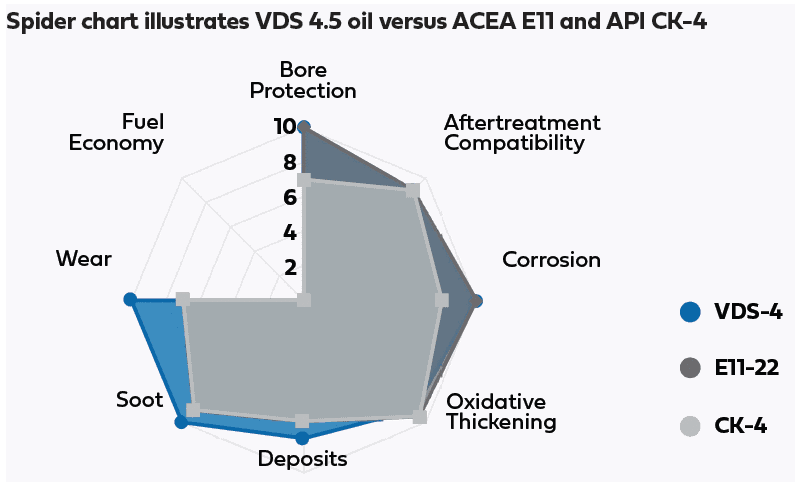
Source : Lubrizol Specification Comparison Chart
Similarly, Cummins CES 20086 is a low SAPS engine oil specification designed for high performance medium and heavy duty diesel engines. It is suitable for use in engines equipped with EGR and DPF emission control systems operating on ultra low sulfur diesel fuel. The specification aligns with Euro Stage IIIB, IV and V off highway emission standards, as well as U.S. Tier 4 requirements.
CES 20086 can also be used in applications where CES 20081 was previously recommended. Lubricants meeting CES 20086 are typically available in 15W-40, 10W-40, 10W-30 and 5W-30 viscosity grades, formulated with API Group II and/or Group III base oils. These products are commonly aligned with other OEM approvals and industry standards, including API CK-4 and ACEA E11.
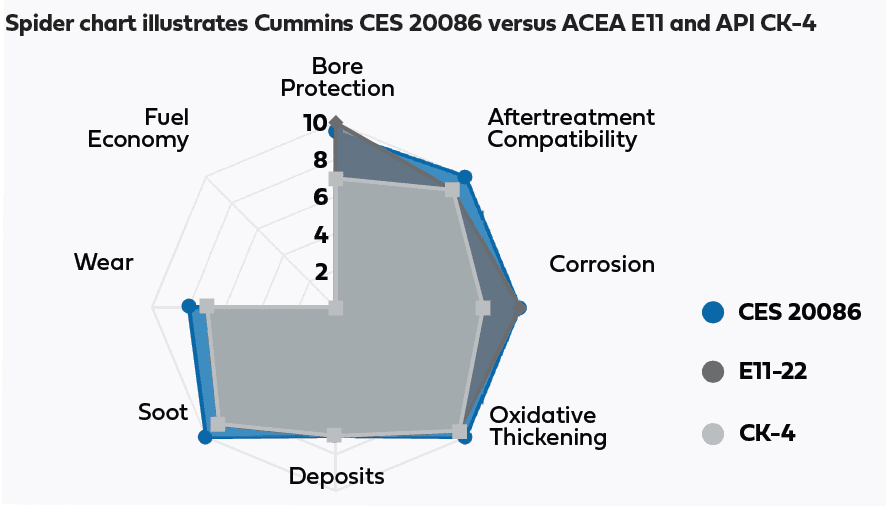
Source : Lubrizol Specification Comparison Chart
Industry standards such as API and ACEA establish the foundational performance requirements for heavy duty engine oils; however, OEMs apply their own stringent specifications to address the unique needs of their engine platforms. Relying solely on API or ACEA classifications – without verifying compliance with the relevant OEM approval – can lead to loss of warranty and increased operational risk. Using a non approved oil may contribute to premature wear, aftertreatment system damage, reduced fuel economy and diminished engine performance.
Engine oils carrying formal OEM approvals incorporate base oils and additive systems tailored specifically to the manufacturer’s performance criteria. These OEM approved additive packages often command a premium due to the extensive testing and certification requirements associated with approval.
An OEM approval signifies that the lubricant has undergone a comprehensive and rigorous evaluation process and has been formally certified as suitable for use in that OEM’s equipment. Obtaining such approval typically requires significant time and investment, often spanning two years or more, reflecting the depth and complexity of the testing involved.
Different trucks, utilised in different applications, will experience dramatically different operating conditions. A linehaul vehicle running steadily at 1500 rpm on sealed highways experiences is subjected to very different stresses when compared with a refuse truck operating in frequent stop start traffic. These specific operating conditions will influence the demands placed on the vehicle and must be carefully assessed when selecting the appropriate lubricant. For example, heauling heavy loads is more likely to lead to heat generation, whilst high idle time – and cooler running temperatures – can introduce the risk of fuel dilution.
Implementing a structured oil sampling and analysis program supports safe drain interval optimisation, provides early indicators of wear or contamination, and helps prevent unplanned failures.
When choosing a heavy duty engine oil, it is essential to consider industry specifications (e.g. API CK-4, ACEA E11), viscosity grade, and critically OEM approvals. Ensuring the lubricant appears on the engine manufacturer’s approved list is vital, as “meets requirements” is not equivalent to “approved.”
Ultimately, aligning lubricant selection with: OEM approvals, operational demands, and data driven maintenance practices ensures maximum engine protection, optimised performance, and long term fleet reliability.
SAPS = Sulfated Ash Phosphorus Sulfur
DPF = Diesel Particulate Filter
EGR = Exhaust Gas Recirculation


Leave a comment
Your email address will not be published. Required fields are marked *