Greenhouse gas emissions driving the change
API CI-4
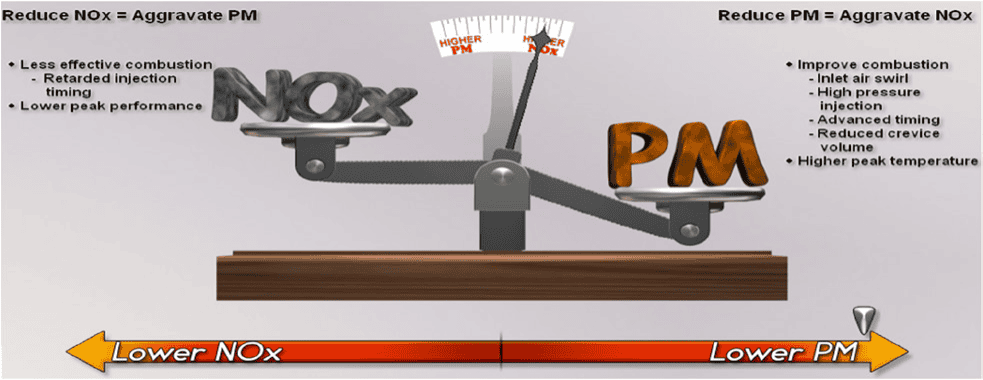
The combustion process is a balancing act between NOx production and soot or Particulate Matter (PM) production. Altering the combustion to reduce one causes the other to increase. This in part led to the two different technologies employed to combat emissions: Exhaust Gas Recirculation (EGR) and Selective Catalytic Reduction (SCR). EGR reduced combustion temperatures and NOx, but created high levels of soot, while engines utilising SCR produced low levels of soot but high levels of NOx which were managed within the catalyst.
EGR is commonly used in the US while SCR was widely adopted in Europe. The high levels of soot loading in the engine oil from EGR required a new specification to control soot related oil thickening, wear, and Base Number control. This specification is API CI-4.
API CJ-4
The upgrade from API CI-4 to API CJ-4 specification in 2007 required diesel fuel quality changes with changes to the way Diesel Engine Oils were formulated. Fuel sulfur levels were limited to <500ppm and a preferred level less than 15ppm, while lubricant Sulphated Ash, Phosphorus and Sulfur levels (SAPS) were limited to <1%. The new requirements were designed to protect after treatment devices such as Diesel Particulate Filters (DPF). DPFs are designed to capture particulate matter in the exhaust gas, reducing particulate matter entering the environment.
API CK-4
CK-4 was designed in response to the US Environmental Protection Agency’s (EPA) latest emission and fuel economy legislation for diesel powered commercial transport vehicles. Its introduction in 2017 required significant improvements in fuel consumption to help reduce carbon dioxide and greenhouse gas emissions. North American OEMs have embraced the new specification because they knew only a high performing diesel engine oil will ensure next generation engines can achieve their full potential for fuel economy without compromising hardware durability.
The American Petroleum Institute (API) is the trade association that represents all aspects of the American oil and natural gas industry. It aims to ensure sound engineering and operating practices in North America and around the globe.
API CK-4 represents an upgrade to CJ-4 oils; in addition, API FA-4 was also introduced. Both utilise some of the tests from API CJ-4, however with stringent limits, with FA-4 focusing on enhanced fuel efficiency for newer engines. CK-4 is designed to be backwards compatible, offering better protection on new and older engine models alike, superseding the API CJ-4 standard.
API FA-4 is not backwards compatible. This standard focuses on highly advanced lower viscosity oils that deliver better fuel economy in new generation diesel engines.
Both new specifications provide improved oxidation resistance, better shear stability and enhanced aeration control to ensure better protection for the newer technology engine platforms.
Oxidation Control
Oxidation is initiated when the lubricant is exposed to oxygen and heat. The process produces harmful by-products, compromising the functionality of the lubricant, shortening its service life and, in extreme circumstances, damaging the engine parts it lubricates.
The internal combustion engine is an excellent chemical reactor for oxidation, with heat and metal engine parts acting as catalysts. Antioxidants are the key additives that protect the lubricant from rapid oxidative degradation, allowing the fluid to meet demanding requirements for use in engines.
Tested in the Volvo T-13 engine test, where the operating temperature is 130°C for 360 hours, CK-4 candidates must have the ability to control oxidation, preventing significant oil viscosity increase.
Shear Stability
Shear stability is a measure of the oil’s resistance to mechanical shear. Polymeric Viscosity Modifiers found in multigrade oils are susceptible to mechanical, and in some cases thermal, shearing that can lead to loss of viscosity. This may prevent the lubricant from protecting the engine parts.
Shear stability is especially important for the FA-4 oils, which are required to be SAE XXW-30 with a High Temperature High Shear (HTHS) of 2.9–3.2 cP. Viscosity loss can jeopardise the oil film thickness, leading to engine wear.
Aeration Control
Entrained gas or foam reduces the lubricant’s ability to cool, clean and lubricate the engine, due to reduced oil pressure and cavitation of the oil film. Higher temperatures and pressures in modern engines can increase air entrainment in the lubricant, therefore it’s important that an oil has excellent aeration performance.
Spider chart showing relative performance
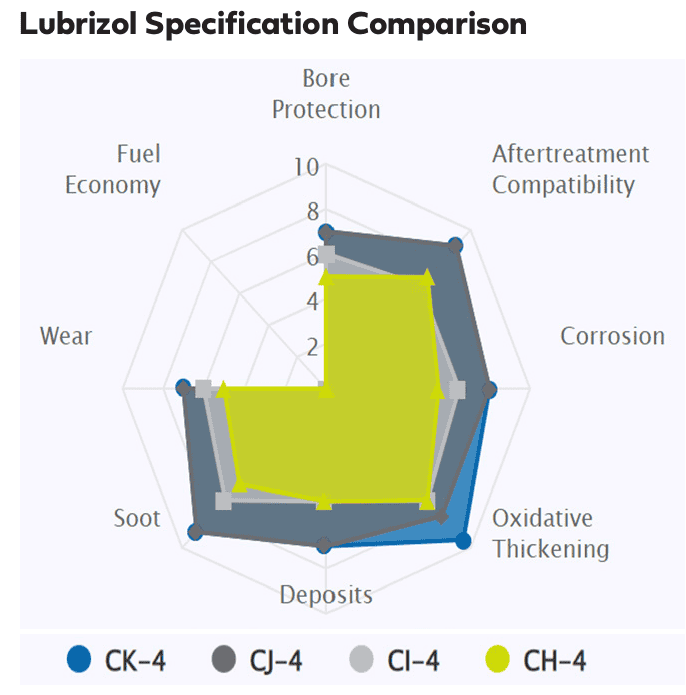
Note: CJ-4 and CK-4/FA-4 oils can only be used with fuel sulfur levels up to 500ppm, however greater than 15ppm may impact exhaust after treatment system durability.

Leave a comment
Your email address will not be published. Required fields are marked *