
What is ACEA?
ACEA is a European Automobile Constructors’ Association that represents Europe’s 16 major car, van, truck, and bus manufacturers. They are the European equivalent of the American Petroleum Institute (API).
The ACEA oil sequences define the minimum quality level for service fill engine oil. Service manuals often recommend ACEA as well as API and JASO specifications. If a manufacturer mandates an ACEA specification, using products without the required ACEA specification may provide inadequate engine protection, shorten the life of after treatment devices and void the manufacturer’s warranty.
For lubricant marketers to claim ACEA specifications, they must submit a letter of conformance to ATIEL. Castrol is a proud member of ATIEL and a signatory to ATIEL’s letter of conformance. You can check whether a lubricant marketer is a signatory at www.sail-europe.eu
ACEA classes
The ACEA: defines the following engine oil classes,
ACEA A/B: for gasoline and light duty diesel engines.
ACEA C: for gasoline and light duty diesel engines with after treatment devices*
ACEA E: for heavy diesel engines.
*After treatment devices include three-way catalytic converters, diesel particulate filters
(DPF), gasoline particulate filters (GPF).
What is new for 2021?
2021 saw the introduction of new and updated light duty ACEA sequences to better serve changing engine technologies. The new sequences focus on LSPI prevention, as well as turbocharger deposits, wear, and fuel economy. All existing sequences have been revised, either discontinued or updated.
Discontinued Categories – A3/B3, C1.
These can no longer be claimed after May 2023. ACEA A3/B4 can be used where ACEA A3/B3 was required. ACEA C1 has no direct replacement, however manufacturers such as Jaguar and Land Rover can continue with OEM or alternative specifications where required.
Introduced Categories – A7/B7, C6.
These categories are based on A5/B5 and C5 respectively. They offer higher performance by including tests for LSPI prevention, timing chain wear, turbocharger deposits and improved fuel economy.
Updated Categories – A3/B4, A5/B5, C2, C3, C4, C5
(all existing categories that have not been discontinued). These have revised requirements for sludge, piston cleanliness, valve train wear and fuel economy
How are ACEA categories different?
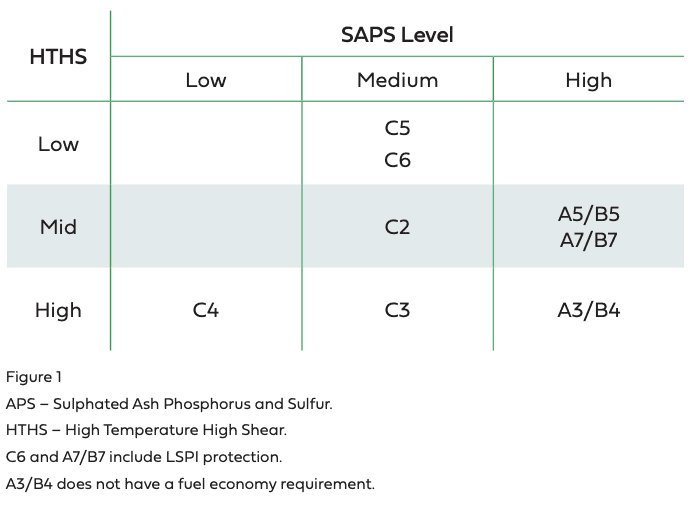
ACEA categories are governed by a set of parameters. Key parameters are HTHS viscosity and SAPS. Lower HTHS viscosity provides better fuel economy, while lower SAPS provides longer life for after treatment devices. See Figure 1. The terms low, medium, and high SAPS, refer to the ACEA limits on certain additives that can be used to formulate an oil.
Combined performance claims
Multiple ACEA categories can be claimed for the same lubricant formulation where all the associated requirements are met. Certain combined claims are technically impossible due to mutually exclusive requirements. One such example is ACEA C3 (SAPS < 0.8) cannot be claimed with A3/B4 (SAPS >1.0). Where both OEM approval and ACEA performance are specified, it is crucial both claims are met. For example, Castrol Magnatec Stop Start 5w-30 A5 is approved against Ford WSS-M2C913D. This
specification is based on ACEA A5/B5 with the addition of Ford specific requirements for fuel economy and timing chain wear.
The importance of industry and OEM relationships
Castrol works closely with several European OEMs, including Renault, Jaguar, Land Rover, and Ford, to develop advanced lubricants that meet all the requirements of each OEM. This demonstrates Castrol’s ongoing commitment to providing high quality lubricants that have been developed through key industry
and OEM relationships.



Leave a comment
Your email address will not be published. Required fields are marked *