

Heat transfer system
A typical heat transfer system has 4 main components, as shown in the figure below.
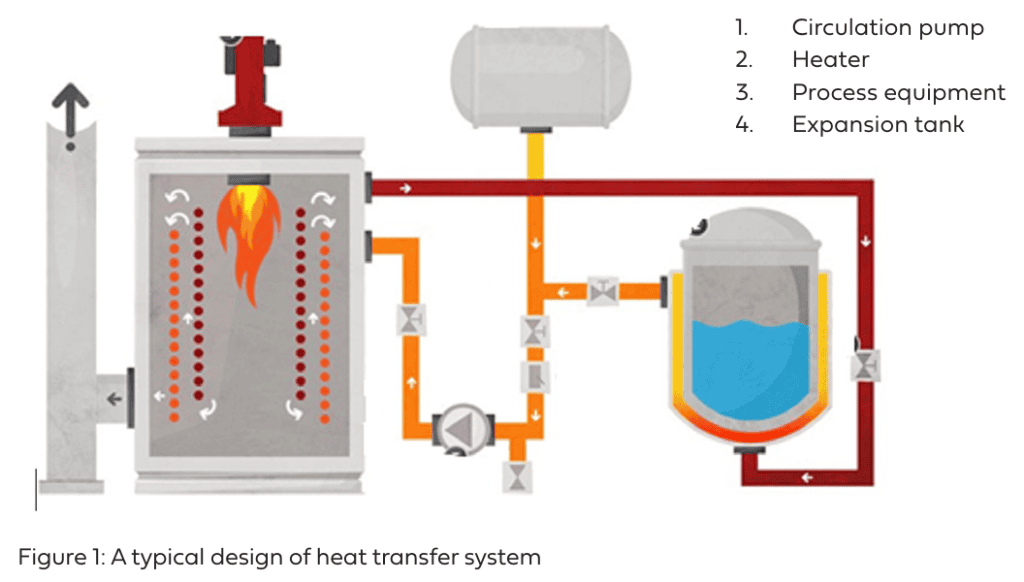
The circulation pump (1) pushes the heat transfer oil through insulated piping to the heater (2) and to the process equipment (3). The expansion tank (4) on the system allows for the expansion and contraction of the hot oil as it heats up and cools down. Most heat transfer oils expand by up to 25% when heated to the maximum recommended bulk temperature. The tank will be ¼ full at ambient temperature and ¾ full at the system’s normal operating temperature. The expansion tank should be installed at the highest point in the system and connected to the suction side of the pump.
Heat transfer fluid application

Requirement of heat transfer fluid
The temperature of the heat transfer oil is raised in the heater by gas, oil, coal, firewood, etc. Therefore, heat transfer oil must have the following properties to adapt to the hot working conditions, carry the heat, and protect the systems – the pumps, valves, pipes, equipment, etc.
- High thermal stability
- High heat capacity & transfer properties
- High thermal conductivity
- Low viscosity at operating temperature & pressure
- Low corrosivity towards system materials
- Low volatility
- Low toxicity
- Available economically
Deterioration of heat transfer oil
The service life and heat transfer efficiency of an oil are significantly affected by thermal cracking, oxidation, and contamination. Therefore, to minimise the influence of the above processes on the heat transfer fluid, please note the following:
• Make sure that the oil passes through the heat exchanger at the correct design speed, arrange the location of the heater appropriately, etc. to avoid local overheating.
• Heat the fluid slowly – do not increase oil temperature too quickly.
• Do not turn off the system suddenly.
• Keep the oil temperature in the expansion tank no more than 60°C. Minimise the direct contact of hot oil with the air.
• Keep fluid clean by minimising contamination into the system.
• For a new system, clean the heat transfer system and remove contamination such as debris, dirt, welding slag, etc. Do not test system pressure with water.
Important notes while using heat transfer fluid
Before filling process
• Check the oil pipeline system and fix any leak points in the system.
• Check the expansion tank: the expansion tank volume must be large enough to hold the oil when the system is working, and the expansion tank must be set high enough.
• The pump and heat transfer oil supply system must be suitable – ensure the flow rate and avoid causing local overheating.
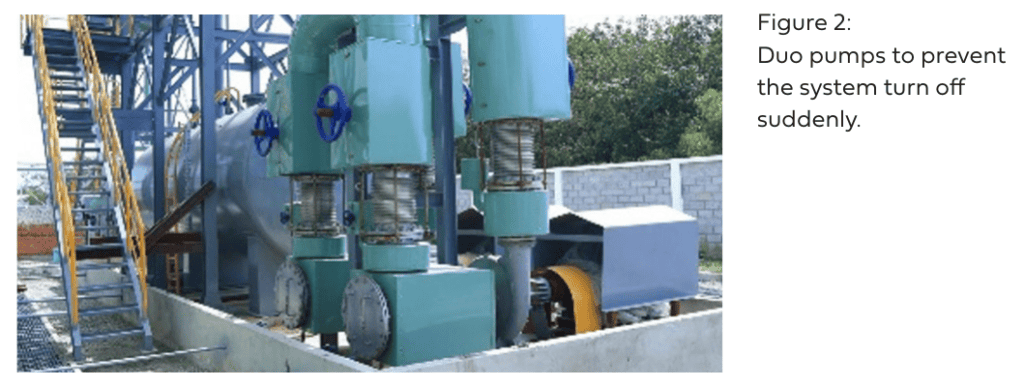
• Arrange backup electric power (generator) and a backup pump in case a mains power failure causes the pump to stop working suddenly.
During filling process
• Check the positions of vents, exhaust, connections, electrical cables, connection bolts, etc.
• Open the vent valves.
• Fill the oil into the tank through the oil pump system at the lowest point to minimise gas entering the system. Stop filling when the expansion tank is about 25% full.
Monitoring heat transfer fluid condition
The fluid should be tested against the 5 parameters below, at least twice per year.
- Kinematic viscosity
- Flash point
- Total acid number
- Carbon residue
- Water by Karl Fischer



Leave a comment
Your email address will not be published. Required fields are marked *