
What is a hybrid vehicle?
A hybrid car, also known as a Hybrid Electric Vehicle (HEV), uses more than one means of energy, combining a petrol or diesel engine with an electric motor. The two systems work with each other to move the vehicle. This allows the car to burn less petrol, achieving better fuel efficiency than a traditional engine that only uses fuel. Electric power serves to boost the performance of the engine. Most hybrids, with the exception of plug-in hybrids, charge the battery through their internal system, and hence don’t need recharging. Plug-in hybrids are halfway between conventional cars and all-electric vehicles: they run on both an electric motor and an internal combustion engine, but can charge their battery by plugging in to an electrical source.
Interesting fact
Did you know that the hybrid drive system is much older than you might think? The oldest vehicle that combined both a petrol and electric engine was a model called the “Lohner-Porsche Mixte Hybrid”, built by Ferdinand Porsche, the founder of Porsche, back in 1899.
Types of hybrid vehicles
Mild Hybrid: A conventional petrol or diesel engine with a low voltage (48V) battery and an electric motor which is typically used to power electric components such as air conditioning and the radio. At low engine speeds, they can supplement the engine with a small electric boost during acceleration, but unlike full hybrids, the electric motor cannot power the car on its own, and they cannot drive in zero-emissions mode.
Full Hybrid: Has an electric motor and internal combustion engine that work together or independently to drive the wheels. It uses high-voltage traction batteries with several hundred volts that work together with the petrol engine to drive the car. Known for fuel savings of 20–50% compared to conventional petrol cars.
Plug-In Hybrid: A plug-in hybrid has a much larger battery pack which can be recharged using an external source. With the amount of electrical energy stored, it can perform an extended all-electric driving range and help reduce the fuel consumption rate significantly.
Practicality of hybrid vehicle production
According to Toyota, when comparing hybrid to electric vehicles (EV), there are three major barriers to having widespread full EV adoption in the market. These include:
Critical Minerals: More than 300 new lithium, cobalt, nickel, and graphite mines are required to meet the expected battery demand by 2035. Given our current mining and processing pace, there will likely be an imbalance between supply and demand.
Charging Infrastructure: The majority of public chargers take anywhere from 8–30 hours to charge a battery. Only 12% of these public chargers are fast chargers, which reduce charge time to 20–60 minutes to achieve 80% charge. Significantly more chargers are required to keep pace with EV adoption in the market.
Affordability: The average purchase price for an internal combustion engine/hybrid vehicle is lower compared to an EV. In addition, consumers will also need to install an at-home charger, incurring additional cost.
To address the affordability and carbon emission challenges, Toyota developed the 1:6:90 Rule:
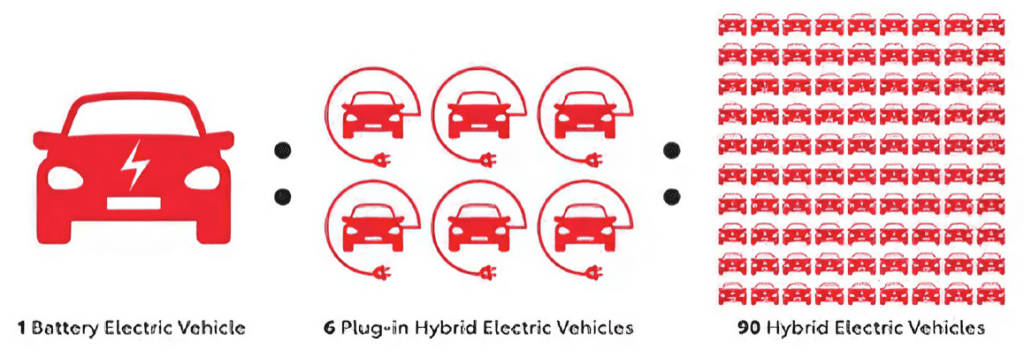
The number of raw materials required to produce 1 long-range EV could instead be used to make 6 plug-in hybrid or 90 hybrid vehicles, suggesting hybrids are more practical in terms of both cost and environmental aspects.
Types of hybrid systems
Parallel Hybrid: The electric motor and the combustion engine are connected to the transmission independently. In stop-start traffic, the electric motor provides power, while at highway speeds the internal combustion engine takes over. However, both the electric motor and engine can move the car during hard acceleration. Additionally, the battery relies on regenerative braking to recharge, as there’s no separate generator to do it.
Series Hybrid: In this system, the electric motor does all the work, while the engine recharges the battery. There is no physical mechanical connection between the engine and transmission. Since the engine only generates electricity to charge the battery, vehicles with this drivetrain are called range-extended electric vehicles.
Series-parallel or Power-split Hybrid: This system combines the advantages of both series and parallel drivetrains. It has a large battery and a powerful electric motor that can drive the wheels, and at the same time the engine can be used to both drive the wheels and charge up the battery pack. Hybrid vehicles with this system tend to use the electric motor in stop-start traffic and during acceleration from standstill, whereas the combustion engine is activated at highway speeds. Sometimes, users may also drive a few kilometres using just the electric motor.


Leave a comment
Your email address will not be published. Required fields are marked *